
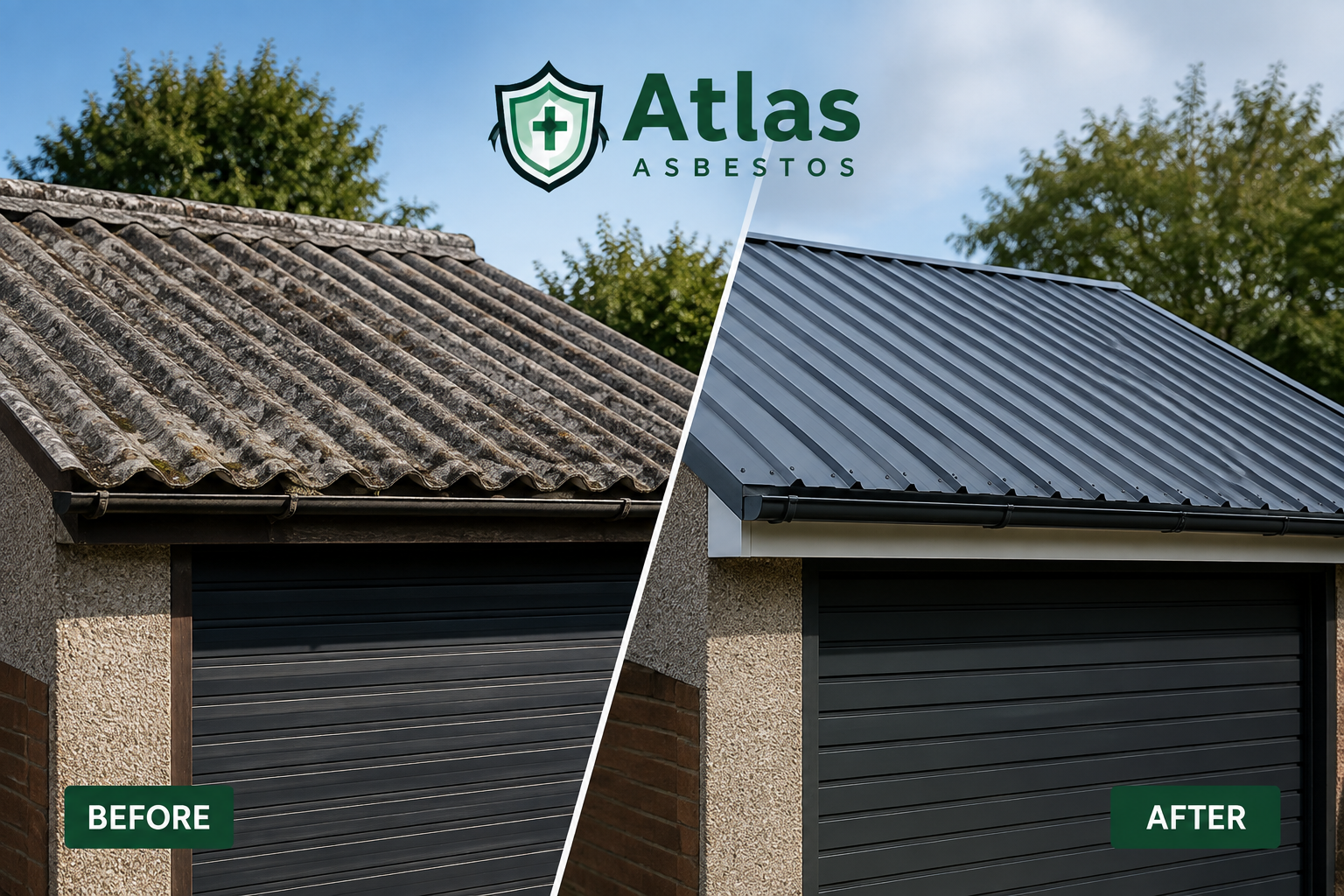
If your garage has an old corrugated cement roof, there is a possibility that it contains asbestos. Asbestos cement was widely used for garages, sheds and other outbuildings across the UK prior to the ban in 1999.
For homeowners, discovering that a garage roof may contain asbestos can understandably raise a number of questions. Is it dangerous? Does it need to be removed? How much will removal cost? And who should carry out the work?
In this guide, Atlas Asbestos explains what you need to know about asbestos garage roofs and how they can be removed safely.
What Does an Asbestos Garage Roof Look Like?
Asbestos cement was commonly manufactured into corrugated sheets and used as a durable, weather-resistant roofing material.
It can be difficult to identify asbestos cement simply by looking at it. Older corrugated grey cement sheets may contain asbestos, but similar-looking asbestos-free products also exist.
If you’re unsure whether your garage roof contains asbestos, the safest approach is to have the material properly assessed or sampled rather than attempting to identify it yourself.
The Health and Safety Executive (HSE) identifies asbestos cement as a hard material made from cement mixed with asbestos fibres.
Never drill, cut, sand, pressure wash or deliberately break a suspected asbestos roof to try to identify it.
Is an Asbestos Garage Roof Dangerous?
An asbestos cement roof that remains in good condition and is left undisturbed generally presents a lower risk than many other asbestos-containing materials because the fibres are well bound within the cement matrix.
However, problems can arise when asbestos cement becomes damaged or is disturbed.
This could happen when a roof is:
- Cracked or badly weathered
- Broken during building work
- Drilled or cut
- Removed incorrectly
- Demolished
- Damaged while replacing the garage
Disturbing asbestos-containing materials can release fibres into the air, which is why appropriate precautions are essential.
An asbestos garage roof does not necessarily need to be removed simply because asbestos is present. If it is in good condition and unlikely to be disturbed, leaving it in place and managing it may sometimes be appropriate.
When Should You Consider Removing an Asbestos Garage Roof?
Removal may be worth considering if the roof has deteriorated significantly, you’re planning to demolish the garage, you’re refurbishing the building, or you want to replace the existing roof with a modern roofing system.
You may also decide to remove it as part of wider property improvement works.
Before starting work, it’s important to establish exactly what material you’re dealing with and its condition.
How Is an Asbestos Cement Garage Roof Removed?
Professional removal should be carefully planned to minimise the possibility of asbestos fibres being released.
HSE guidance for removing asbestos cement sheets says that breaking the material should be avoided or minimised. Fixings should be carefully released and large sheets should be lowered to the ground rather than dropped.
A typical garage roof removal carried out by Atlas Asbestos may involve:
1. Assessment
We assess the garage, roof condition, access requirements and the extent of the asbestos-containing material.
2. Planning the Work
The removal is planned so the appropriate equipment, protective measures and waste arrangements are in place before work begins.
3. Careful Removal
Roof sheets are carefully released from their fixings and removed with the aim of keeping them intact wherever reasonably practicable.
Asbestos cement roofs should also be treated as fragile roofs and appropriate working-at-height precautions are essential.
4. Packaging and Disposal
Removed asbestos materials are appropriately contained and transported for disposal in accordance with applicable waste requirements.
Asbestos waste cannot simply be placed into ordinary household or general waste. Government guidance requires construction materials containing asbestos to be sent to an appropriate hazardous-waste landfill or a suitable separate cell at a non-hazardous landfill.
5. Final Inspection
Once the asbestos cement has been removed, the working area is checked and any relevant asbestos debris is dealt with before the area is handed back.
Do You Need a Licensed Asbestos Contractor to Remove a Garage Roof?
Removal of asbestos cement sheets can fall within non-licensed asbestos work when the material can be carefully removed without substantial breakage. HSE specifically lists careful removal of asbestos cement roof sheets as an example of non-licensed work.
However, that does not mean asbestos cement should be treated like ordinary building material.
The people carrying out the work still need appropriate information, instruction and training, and the work must be properly assessed and controlled.
If asbestos cement is likely to be substantially broken up, creating significant dust and debris, the work may become notifiable non-licensed work (NNLW).
This is one reason why using an experienced asbestos contractor can give homeowners reassurance that the material is being handled and disposed of correctly.
Here at Atlas Asbestos we are trained, insured and capable of carrying out these removal works safely.
How Much Does Asbestos Garage Roof Removal Cost?
There isn’t one fixed price because every garage is different.
The cost will usually depend on factors such as:
- The size of the garage roof
- The quantity of asbestos cement
- The condition of the sheets
- Access around the garage
- Height and working-at-height requirements
- Whether scaffolding or specialist access equipment is required
- Waste volume and disposal requirements
- Whether additional asbestos-containing materials are discovered
A small, straightforward single-garage roof with good access will naturally cost less to remove than a large double garage or outbuilding with difficult access.
At Atlas Asbestos, we can assess your requirements and provide a clear quotation based on the actual work involved rather than relying on a generic price per square metre.
Can I Remove an Asbestos Garage Roof Myself?
Some asbestos cement work is legally classed as non-licensed work, but that shouldn’t be confused with the work being risk-free.
HSE publishes specific procedures for asbestos cement removal covering PPE, respiratory protection, controlling breakage, handling sheets and waste disposal.
There is also the significant issue of working at height. HSE explicitly warns that asbestos cement roofs are fragile and cannot be assumed to support a person’s weight.
For many homeowners, using trained professionals is therefore the safest and simplest option.
What Happens to the Asbestos After Removal?
Asbestos waste has specific disposal requirements and cannot be disposed of as normal building waste.
For example, Merseyside’s household asbestos disposal arrangements accept certain cement-bonded asbestos from residents, but specifically state that asbestos generated by a contractor becomes trade waste and isn’t accepted through that household service.
When you employ a professional contractor, appropriate waste arrangements should form part of the job.
Asbestos Garage Roof Removal in Liverpool & the North West
Atlas Asbestos provides professional asbestos services for homeowners, landlords, businesses and contractors across Liverpool, Merseyside, Manchester and the wider North West.
Whether you’ve discovered a suspected asbestos cement garage roof, you’re planning a refurbishment, or you want an old garage roof removed before installing a replacement, our team can assess the job and advise you on the appropriate next steps.
Need an Asbestos Garage Roof Removed?
Contact Atlas Asbestos today to discuss your garage roof and arrange a quotation.
If you’re unsure whether your roof contains asbestos, get in touch before disturbing the material. We can help you determine the appropriate next step.
Atlas Asbestos — Safe. Professional. Reliable.
 Previous Post
 Next Post
