
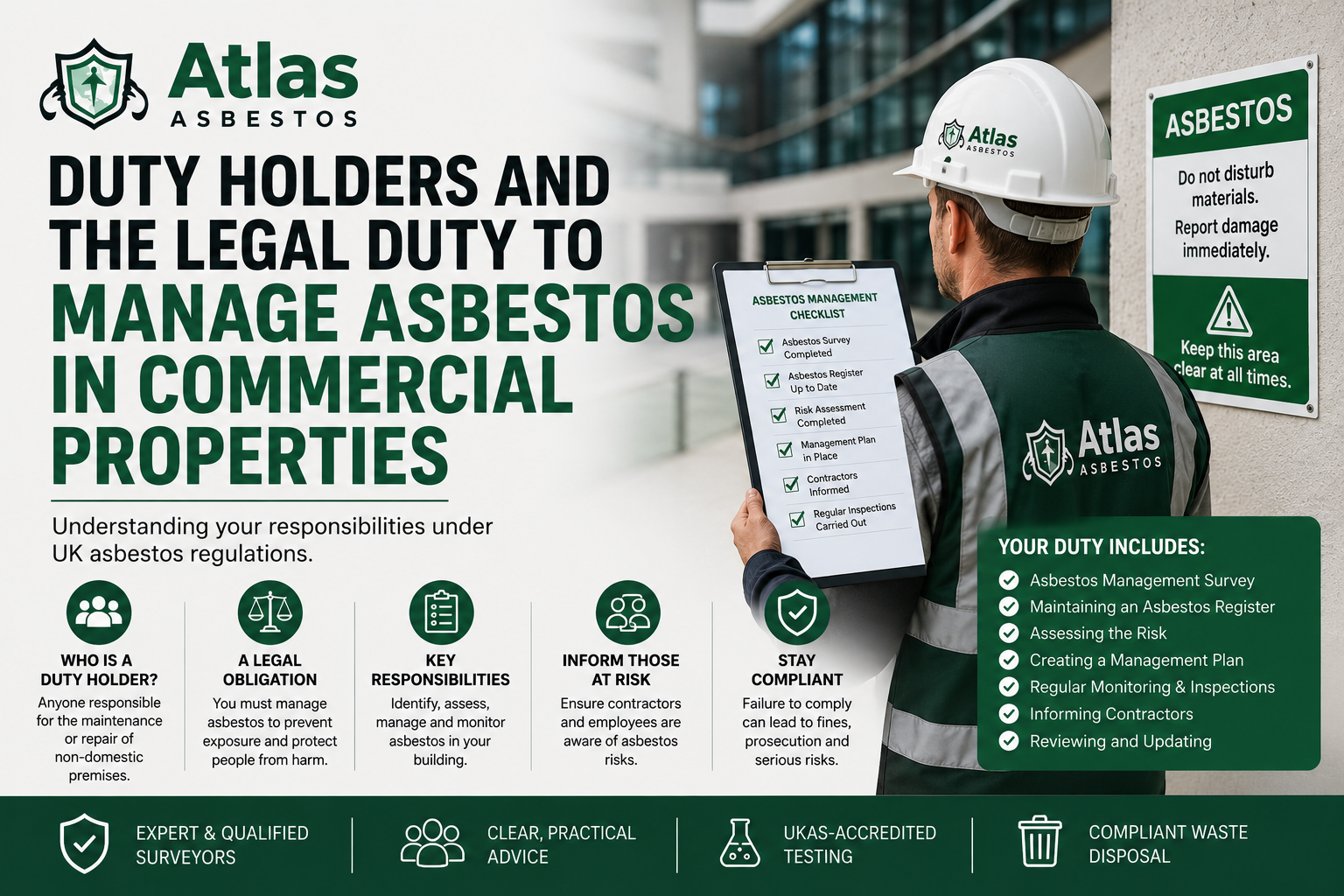
If you own, manage, or are responsible for a commercial property built before 2000, you may have legal duties regarding asbestos management.
Many duty holders are unaware that UK asbestos legislation places specific responsibilities on those responsible for the maintenance and repair of non-domestic premises. Failure to comply can lead to significant fines, prosecution, project delays, and potentially serious health risks for building occupants and contractors.
In this guide, we’ll explain who a duty holder is, what their responsibilities are, and how to remain compliant with current asbestos regulations.
What Is a Duty Holder?
Under the Control of Asbestos Regulations 2012, a duty holder is the person or organisation responsible for the maintenance or repair of non-domestic premises.
This could include:
- Commercial property owners
- Landlords
- Facilities managers
- Managing agents
- Employers
- Building managers
- Occupiers with maintenance responsibilities
In some cases, responsibility may be shared between multiple parties depending on lease agreements and contractual arrangements.
What Is the Duty to Manage Asbestos?
Regulation 4 of the Control of Asbestos Regulations 2012 places a legal obligation on duty holders to manage asbestos within non-domestic premises.
The purpose of the duty is simple:
To prevent people from being exposed to asbestos fibres.
The duty applies to a wide range of buildings, including:
- Offices
- Shops and retail units
- Schools and colleges
- Hospitals and healthcare facilities
- Warehouses
- Industrial premises
- Hotels
- Communal areas of residential buildings
If asbestos is present and remains in good condition, it can often be managed safely. However, duty holders must know where it is, assess its condition, and ensure it does not pose a risk.
What Must Duty Holders Do?
1. Identify Whether Asbestos Is Present
The first step is determining whether asbestos-containing materials (ACMs) exist within the building.
This is typically achieved through an Asbestos Management Survey carried out by a competent asbestos surveyor.
Without a survey, it is difficult to demonstrate compliance with asbestos regulations.
2. Maintain an Asbestos Register
Any identified asbestos-containing materials should be recorded within an asbestos register.
This document should include:
- Material locations
- Material types
- Condition assessments
- Risk ratings
- Photographs where appropriate
The register should be regularly updated whenever inspections or remedial works take place.
3. Assess the Risk
Not all asbestos materials present the same level of risk.
Duty holders must assess:
- Material condition
- Accessibility
- Likelihood of disturbance
- Building occupancy
- Maintenance activities
This information helps determine the most appropriate management strategy.
4. Create an Asbestos Management Plan
An asbestos management plan outlines how asbestos risks will be controlled.
A management plan should include:
- Inspection schedules
- Monitoring procedures
- Emergency arrangements
- Responsibilities of relevant personnel
- Procedures for contractors working onsite
This document should be reviewed periodically and updated when circumstances change.
5. Inform Anyone Who May Disturb Asbestos
One of the most important legal responsibilities is ensuring that anyone likely to disturb asbestos is made aware of its presence.
This includes:
- Contractors
- Electricians
- Plumbers
- Maintenance teams
- Builders
- Engineers
Providing asbestos information before work begins can prevent accidental exposure and costly project delays.
What Happens If Duty Holders Fail to Comply?
The Health and Safety Executive (HSE) takes asbestos management extremely seriously.
Failure to comply with asbestos regulations can result in:
- Improvement Notices
- Prohibition Notices
- Criminal prosecution
- Unlimited fines
- Reputational damage
- Civil claims
Beyond legal consequences, poor asbestos management can place employees, contractors, and members of the public at unnecessary risk.
Does Asbestos Always Need to Be Removed?
No.
Many asbestos-containing materials can remain in place if they are in good condition and unlikely to be disturbed.
In these situations, management and monitoring may be the safest and most cost-effective solution.
Removal is generally considered when:
- Materials become damaged
- Refurbishment works are planned
- Demolition is proposed
- The risk of fibre release increases
A competent asbestos professional can advise on the most appropriate course of action.
How Atlas Asbestos Can Help
At Atlas Asbestos, we help commercial property owners, landlords, facilities managers, and businesses meet their legal asbestos obligations.
Our services include:
- Asbestos Management Surveys
- Refurbishment and Demolition Surveys
- Asbestos Sampling and Testing
- Asbestos Registers
- Management Plans
- Non-Licensed Asbestos Removal
- Asbestos Waste Disposal
We work with businesses across Liverpool and the North West to ensure asbestos risks are identified, managed, and controlled in line with current legislation.
Need Help Meeting Your Duty to Manage?
If you’re responsible for a commercial property and are unsure whether your asbestos management arrangements are compliant, Atlas Asbestos can help.
Our experienced team can provide surveys, testing, and practical advice to help you fulfil your legal responsibilities and protect everyone who uses your building.
Contact Atlas Asbestos today to discuss your asbestos management requirements.
 Previous Post
 Next Post
